ARR Doesn't Mean What It Used To
From uloza+hey@proton.me · original ↗ · unsubscribe
ARR is now the most distrusted metric in the room because different definitions exist: is it revenue or GMV? Is it recurring? Is it quarterly × 4? Or 365 × daily revenue? Founders who spell out their ARR math up front build more credibility than any growth rate can.
ARR Doesn’t Mean What It Used To
15 VCs on the metrics they no longer trust at face value
[

](https://substack.com/@sim0nwu)
Jul 28, 2026
15
2
1
Share
[

](https://substackcdn.com/image/fetch/$s_!PgK7!,f_auto,q_auto:good,fl_progressive:steep/https%3A%2F%2Fsubstack-post-media.s3.amazonaws.com%2Fpublic%2Fimages%2F77a560b6-c41f-4e3d-a98a-a0178423b4d0_2240x1260.png)
Joseph Floyd, Partner at Emergence Capital, put it plainly: “I’ve stopped believing all metrics. ARR is now almost always some form of annualized revenue run-rate. Closed ACV bookings might be a POC or could still be late-stage pipeline.”
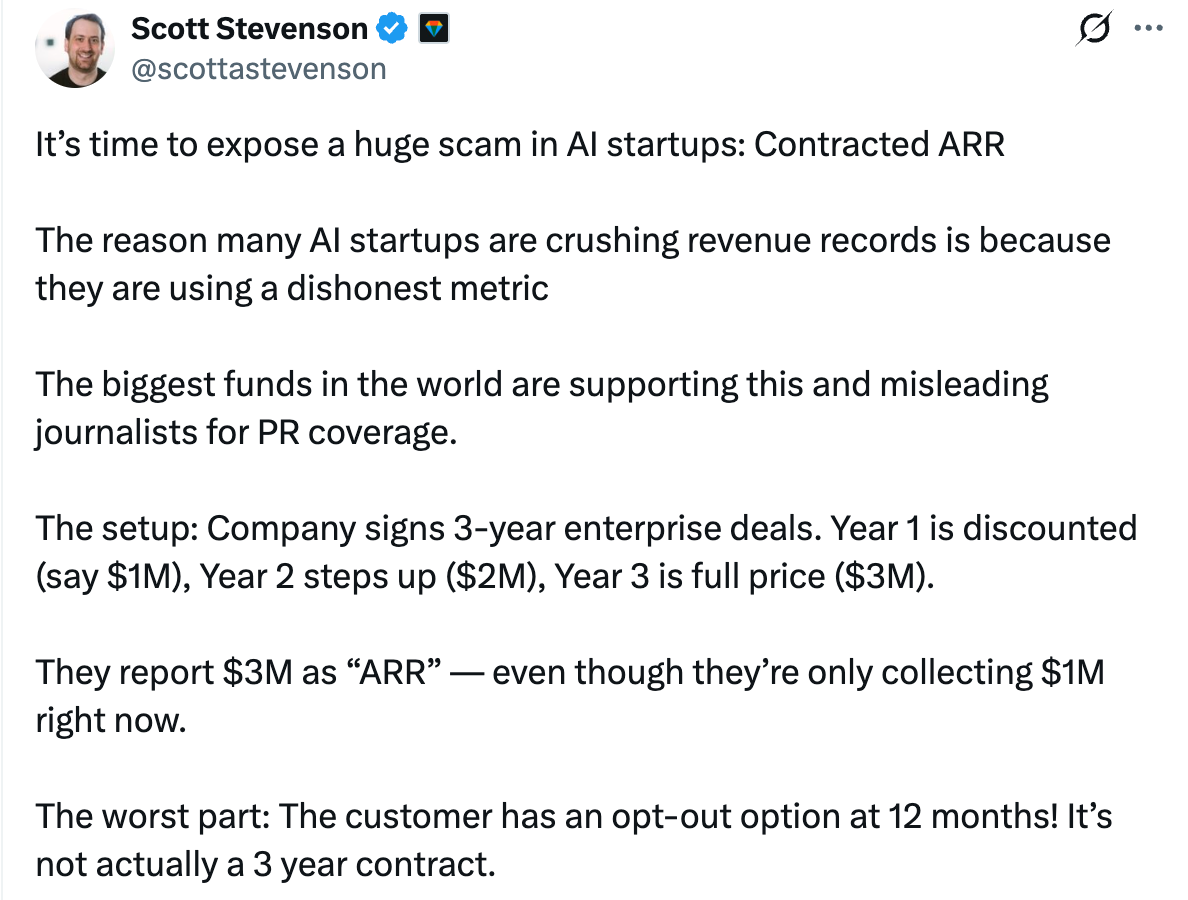
There’s been chatter that founders and VCs are using inflated ARR to “kingmake” / pick winners on numbers that don’t hold up. Instead of taking the hot take at face value, I asked the people writing checks: what’s the metric you no longer trust, and what’s it usually hiding?
[
](https://substackcdn.com/image/fetch/$s_!Rfky!,f_auto,q_auto:good,fl_progressive:steep/https%3A%2F%2Fsubstack-post-media.s3.amazonaws.com%2Fpublic%2Fimages%2Fa48f678e-4cb3-4f1d-9935-1063fd059606_1188x900.png)
The most popular answer: ARR itself
More people named this than anything else. The term has quietly stopped meaning one thing.
Thanks for reading Signals By Simon! Subscribe for free to receive new posts and support my work.
Subscribe
Niko Bonatsos, Founder and Managing Director at Verdict Capital: “ARR… Is it revenue or GMV? Is it recurring? Is it quarterly * 4? Or is it 365 * daily revenue (not kidding - have seen that too!!)?”
Jeff Weinstein, Partner at FJ Labs: “I suspect everyone will coalesce around not believing ARR, which is almost never recurring these days. Every company is now 0-10 or 0-50 in a year. While it’s true there are many unprecedented-growth stories, you need to be skeptical of the numbers and what’s actually being reported.”
Vivek Ramaswami, Partner at Madrona, put a different spin on the same observation: “There are just so many different variations of ARR at this point, so it’s less ‘do I believe your metric’ vs. ‘how do you define what this metric is.’ I encourage founders to include a definition of ARR in their deck, or at least voice over it, so investors know how it’s calculated. Is it actual recurring revenue with durability, or an annualized figure? Both can still be signals of great companies, but it’s helpful to know how to think about the nature of the business.”
Vivek’s suggestion is a good one: A founder who explains their ARR math on slide one builds more credibility than any growth rate can.
The runner-up: CARR
If ARR is bent, CARR (contracted/committed ARR) worries people more.
A Partner at a large crossover fund: “I don’t know why so many companies try to now raise off of a ‘CARR multiple’ instead of an ARR multiple. It’s not a real number… We’ve seen that it doesn’t all convert, and sometimes the drop-off can be quite large, so giving the ‘valuation credit’ seems like a fake way to do valuation. The gap isn’t always predictable either - sometimes customers change their mind, sometimes they just don’t onboard, and sometimes the implementation period can be unpredictable. We would prefer to just hear ARR in the pitch rather than CARR.”
Kevin Tu, Partner at DFJ Growth: “I’ve stopped taking contracted run-rate at face value, particularly for the startups supplying training data and RL environments to frontier AI labs, as it conflates signed bookings with realizable revenue capacity. Eight-figure SOWs signal genuine demand and a supply-side crunch, but are often a poor proxy for revenue: recognition hinges on milestone delivery, customer testing and acceptance, and the vendor’s ability to scale increasingly complex, bespoke work. Because the definition of high-value training data evolves alongside model capabilities, a large backlog may not convert into revenue on a predictable timeline. Ultimately, underwriting the revenue requires going under the hood on both the technology and the scalability of the delivery model.”
Ankit Sud, Partner at NewView Capital, sees the same pattern from a different angle: “Contracted or signed ARR has lost its meaning among AI businesses. This isn’t dissimilar from fintech companies quoting signed payment volume. Instead, we look at live ARR and validate estimated usage ramp by speaking directly to customers about their expectations.”
The consumption-pricing wrinkle
A few responses zeroed in on a specific aspect of how AI products are actually priced.
Francisco Gimenez, Partner at 8VC: “For PLG/consumer, annualized revenue is too misleading. Specifically because so many of these companies are doing blended recurring and consumption pricing models. So you can annualize the recurring monthly revenue – which is still technically wrong unless they are yearly contracts – but you shouldn’t annualize the consumption side until it is truly predictable, which is not usually the case at the early stage.”
Shaun Lee, Partner at Mubadala Capital: “I’ve become cautious of run-rate revenue or ARR for capital-intensive AI infrastructure businesses when it is presented without cash conversion. Revenue may be underpinned by leverage, revenue-sharing arrangements, equipment financing, or large upfront infrastructure commitments, so the headline growth may obscure how much economic value is actually accruing to the company. I want to understand the FCF profile after financing costs and the capital required to deliver that revenue.”
David Roos, Partner at Core Innovation Capital: “Been seeing a lot of ARR annualized off one hot month. Particularly for AI-native services, there’s a lumpiness and uncertainty that needs to be accounted for.“
Gross margin
Everyone expects the ARR pile-on. A few people flagged gross margin:
Sunil Chhaya, Co-Founder & General Partner at Kearny Jackson: “Gross margin, at least for anything compute-heavy that isn’t priced on usage. If pricing is flat but costs scale with usage, that margin number is really just a bet that customers won’t use the product much. We’ve seen founders underestimate compute costs in their GM assumptions over and over, so the number holds up right until the product starts working. Then usage grows, pricing stays put, and margins get squeezed at the exact moment the business succeeds.“
Vivek Krishnamurthy, Partner at Commerce Ventures, flagged a related but distinct version of the same problem: “The metric I actually see equally abused is gross margin. A lot of the AI-native companies I see have an FDE motion, but they push the bulk (or all!) of that cost below the line in OpEx. It only takes a customer call or two to realize that FDE/integration costs scale somewhat linearly with revenue growth for some of these companies. In a world where that FDE cost was accurately portioned, I suspect we’d see a lot fewer ‘>70% GM’ companies!”
The gross margin looks clean because a real cost is hiding somewhere else on the P&L. That’s an uncomfortable thing for a founder to sit with, but it’s a pricing and accounting conversation waiting to happen either way.
NRR
Nikhil Basu Trivedi, Co-Founder & General Partner at Footwork “I’m actually increasingly skeptical of NRR bc we’re seeing a lot of companies start with small POCs and then convert those to contracted ARR, and then include that to produce an amazing NRR metric that doesn’t really feel apples-to-apples with traditional definitions of NRR.”
And the more structural take
A partner at a growth stage fund: “At the growth stage, I don’t think there is as much obfuscation of metrics or worry about companies misleading you. I think the dynamic we are seeing is just that it is hard to do metrics-based investing. Pre-AI, one could look at growth, NRR, GRR, burn - easily benchmark it across companies and then use those metrics as heuristics to invest. In the AI era, you see a lot of incredible growth rates, and it is more about making a qualitative judgment call around durability.“
Founders aren’t squinting more than they used to. The old playbook, benchmark growth, NRR, GRR, burn against last year’s comps, was built for slower growth curves and simpler pricing. AI broke both assumptions, a new playbook has not yet been established.
One more, from a different corner of the market
Everything above is a SaaS story in some sense. But the same failure mode shows up outside software too - it’s just wearing a different metric’s clothes.
Jason Kalira, Partner & Head of Seed Fund at Westly Group:
“Two metrics that jump out to me in physical AI decks specifically, both versions of the same problem – a demo environment standing in for the real world.
The first is autonomy rate. Founders love to show ‘95% task completion, fully autonomous,’ and it’s almost always measured in a controlled pilot with clean lighting, consistent materials, and an engineer standing nearby to intervene. In the time I’ve spent on factory floors with our partners, that number moves a lot once you introduce real-world variability, and nobody’s updating the slide to reflect it. I’d ideally like to know the autonomy rate after 90 days in production, not week one of the pilot. The second is pipeline built from signed LOIs and MOUs, which show up constantly in industrials and energy decks as a stand-in for revenue visibility. Those documents are usually non-binding, carry no penalty for walking away, and often get signed early in a vendor evaluation process, well before budget is allocated or a purchasing decision is final. I want to know how many have a PO or a deposit behind them.
Both come down to the same thing: a number generated under ideal conditions getting presented as if it’s steady-state.”
Swap “autonomy rate” for ARR and “signed LOI” for CARR, and it’s the exact same conversation the SaaS investors above are having. The pattern isn’t specific to any one sector or metric - it’s what happens whenever a number gets measured under ideal conditions and then quoted as if those conditions are permanent.
My takeaway
If you’re a founder reading this: nobody here is hunting for a reason to say no. It comes down to three questions. Is it working? How well? What can you actually extrapolate from that? ARR flavors, CARR, autonomy rate under studio lighting, all decoration, and hype like this gets exposed eventually. Founders don’t get to pick which metric leads the conversation. They get to pick whether they’re managing expectations or building something that survives when the lighting changes.
What’s the next topic you want an unfiltered signal on?
Thanks for reading Signals By Simon! Subscribe for free to receive new posts and support my work.
Subscribe
15
2
1
Share